
Whilst out on a walk with my dog, I’m thinking about how my rut is that my website and my social media have not been flowing because I’ve not been feeling alive with it. I never want to share when it’s forced and inauthentic. Standing now here, on the edge of this tiny little wood – which is filled with aconites and snowdrops, which are those tiny little yellow and white woodland flowers that bloom seemingly early as it’s still winter. They’re there to sense into any winter warmth and light and their bloom offering us their welcome colour.
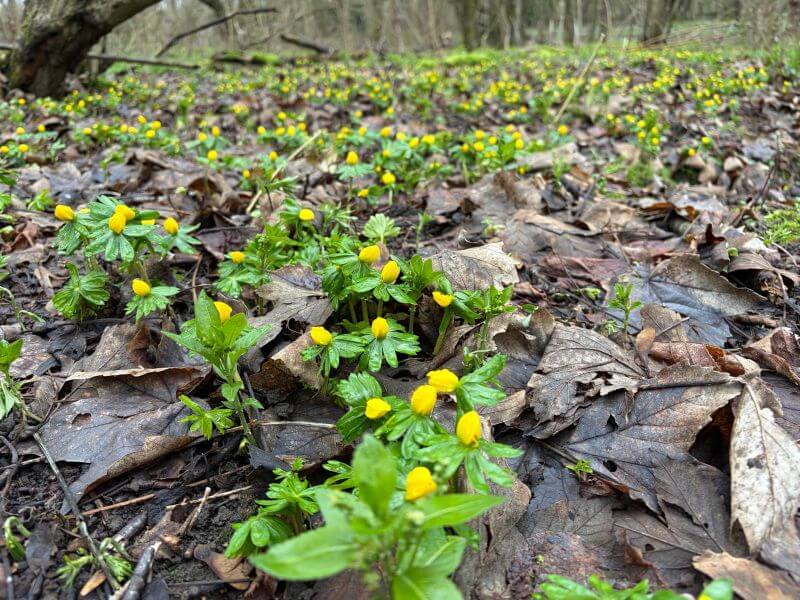
What can we do to move from a mindset around the dreariness of the ‘drudginess’ of wintertime with the endless mud, rain, floods, news and heaviness of all that which we tend to shove on our backs? And how can we take on more of the energy and impact that the aconites and snowdrops have in our world.
I also heard a report on the news today about lichen and the importance and significance of lichen, and how most of us don’t even notice them. There are hundreds of different types, and they tell us so much about our environment and how healthy it is.
And I just wonder if we were to examine and explore our own environments. Where are the snowdrops? Where are the aconites? Where are the multitude of different lichens in our worlds, in our social woodlands? What is supporting us, and what is dragging us down? And what can we do to shake that up and cut it back and feel more alive and in tune?
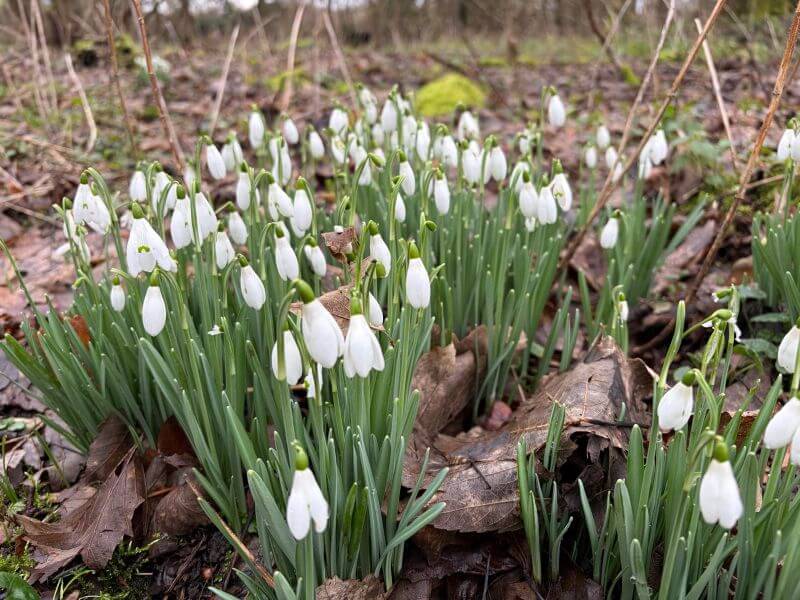
There are certain times of the year to cut branches back on hedgerows and large overhanging trees. And now, during the dormant season, when all the goodness is being maintained underneath the ground, unseen by the naked eye, we can cut back to replenish, to create space for new growth. This the cut-back is often scary. It can feel too dramatic, or forceful, or even aggressive.
It’s like when you cut a rose bush right back to nearly ground level and you think, “Oh my goodness, have I taken it too far? Will it ever grow back?” And then come midsummer, you’ve got this huge, prosperous rose bush bursting into life with so many blooms, and there’s no disease or black spots because you had the courage to act when it needed it.
This season for me is like a permission slip to look at our environments and really consider who’s there, what’s there, why it’s there, and what it’s doing?
Are your social environments offering you grounded support? The positivity you deserve, encouraging you to be brave and step forward? Or encouraging you to rest and incorporate learning and reflection? Or is it pushing you too hard, straining you, feeling like dead weight, tangling you up in knots and pulling you down?
Just notice, first, the environments you are spending much of your time in. And then imagine if you were to cut back. Not clean through. We’re not talking about a massive spring clean. We’re talking about trimming branches, cutting strings, tidying hedgerows to enable the bushes to be strong come spring, fresh and full of life, so they can support all those nests for the robins and blue tits. Because if we let them grow too long, they get thin and they break under the pressure of their load.
So where can you offer yourself some winter cut-back? And what does that look like?
I’d be intrigued to hear if this concept touches or resonates with you. Often, when I’m on these thought processes on walks, I never speak it out loud and concepts pass by in the wind. Today I have been brave and recorded to bring them to life in a blog. I just look at the brambles and thick, wicket hedgerows full of ivy and prickly hawthorn, and think how refreshing it would be to trim some of it back. Just a little bit. Not taking away its maturity or wisdom just untightening its belt one notch and letting it breathe deeply.
Another fact I heard on the radio today was about emotional maturity. The older we get, the more able we are to identify emotions, empathy, and how people show up. Their reactions, their behaviours, their facial expressions. When we’re younger, or even in our middle years, we might not have the sensitivity to notice these things. But over time, you receive these signals almost instantly.
You become more grounded, wiser; someone people want to be around. And that’s because your environment is enabling you to be that person.
For a moment I’m distracted and find myself contemplating the old man’s beard, all tangled up and knotty and I know that in a few months’ time, these pathways will be luminous with new fresh lime-green leaves. And the paradox that offers.
I’ll end with an invitation to take a moment to notice, in this quieter time of year, where you feel when most alive and who is around you. Write it down. Commit it to memory. Place yourself in those environments more often.
If you need to, mark how you feel. Journal it. Voice notes count as a journal. Get the sticky rut out of your body. What you want to say, write, scream, shout. It does no good being stuck inside. It can be cathartic, freeing to give it some space.
Notice where you can do that and be in those environments more frequently. Refresh yourself. Shake yourself down, brush off from your body all that you want to rid. Animals do this instinctively. A dog stretches, then shakes off all the energy it needs to release.
Be wilder with your instinctive wisdom!
From the footpath to your screen.
With love
Sam x
Working on the inside, outside